Can I claim if I slipped on a grape in Aldi?
Possibly. If the grape was crushed or dirty, that can suggest the hazard had been there a while and point to a failure to inspect. In England and Wales you generally have 3 years to claim.
Quick answer
If you slipped, tripped or fell in a supermarket in England or Wales because of a hazard the store should have dealt with, you may be able to claim compensation under the Occupiers' Liability Act 1957. The usual time limit is three years from the accident. Many claims are funded on a No Win No Fee basis.
Edward & Amaury Solicitors (Carlisle) assess supermarket accident claims in England and Wales, including against Tesco, Sainsbury's, Asda, Morrisons, Aldi, Lidl, Waitrose and M&S. Request a free claim assessment; no obligation. No Win No Fee may be available.
Choose the nearest match. “Not sure” is fine.
Each chain has distinctive accident patterns — pallet trips at Aldi, fresh-counter slips at Morrisons, café spillages at Sainsbury's. Pick yours for store-specific guidance and recent settlement examples.
Need a payout estimate first?
Use our compensation calculatorA supermarket slip or trip claim is a legal action you can take when a store's negligence causes you to be injured. Under the Occupiers' Liability Act 1957, supermarkets must keep their premises reasonably safe. If they fail and you're hurt, you may be entitled to compensation on a No Win No Fee basis.
A supermarket slip or trip claim is a personal injury action made when a retailer fails in their "Duty of Care." Under the Occupiers' Liability Act 1957, businesses are legally required to take reasonable steps to ensure visitors are safe.
A claim arises when a breach of this duty causes a physical or psychological injury. Common examples include:
Spilled milk, leaking freezers, or rainwater near entrances.
Curled-up floor mats, loose 'stair nosing,' or cracked floor tiles.
Abandoned packing crates or 'shrink wrap' left in aisles by staff.
Grapes, berries, and leafy greens are among the most dangerous hazards. Learn why.
A supermarket is legally responsible when it knew about a hazard—or should have known—and failed to act. If the store had no proper inspection system, ignored a reported spill, or created the hazard itself, it has breached its duty of care and you likely have a valid claim.
A supermarket is not automatically responsible for every fall. To win a claim, you must prove negligence. The law focuses on whether the store had a "reasonable" system in place.
The store may be liable if:
They knew about a hazard but failed to fix it or cordon it off.
They did not have a regular 'sweep and log' system to check for spills.
The hazard was created by a staff member (e.g., mopping without a sign).
The hazard had been on the floor for a duration that exceeds their own safety policy.
Success in a claim depends heavily on the evidence gathered at the scene. If you are able, follow these steps:
You need five key pieces of evidence: an accident book entry, photographs of the hazard, witness contact details, a formal CCTV preservation request, and medical records from your GP or A&E visit. Gathering these at the scene dramatically increases your chances of a successful claim.
Ensure the manager records the fall in the Accident Book. Check that the details are accurate before you leave.
Take photos of the floor, the spill, or the trip hazard. Include a wide shot to show the lack of warning signs.
Ask for the names and numbers of other shoppers. Staff members are often reluctant to provide statements later.
Formally request that the store saves the footage.
Even for minor pain, see a GP or A&E. Your medical records serve as the primary link between the accident and your injury.
Tesco, ASDA, and other large chains have dedicated legal teams. Learn how to navigate their systems.
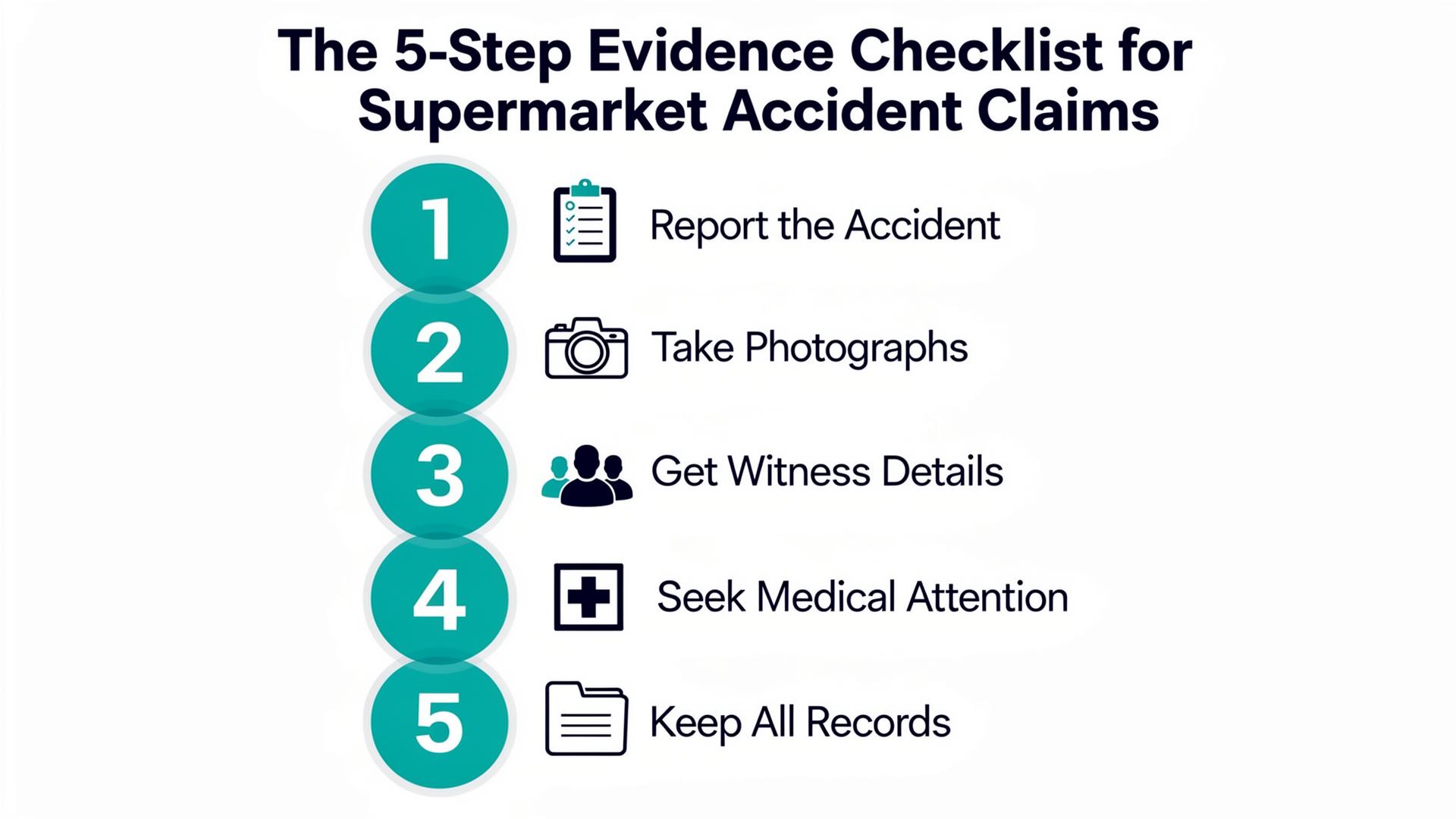
Save or print this checklist to use at the scene of an accident.
Compensation is divided into two categories: General Damages (pain, suffering, and loss of amenity) and Special Damages (out-of-pocket expenses).
Compensation for supermarket injuries is valued using the Judicial College Guidelines, according to the injury and how long it takes to recover. On top of this, you can claim for lost wages, medical costs, and care expenses. Most claims are handled on a No Win No Fee basis.
| Bracket | General damages (2026) |
|---|---|
| Minor back injury – type (iv)Recovery within 3 months | Up to £3,240 |
| Minor back injury – type (iii)Recovery between 3 and 12 months | £3,240 to £5,750 |
| Minor back injury – type (ii)Recovery between 12 and 24 months | £5,750 to £10,420 |
| Minor back injury – type (i)Recovery between 2 and 5 years | £10,420 to £16,520 |
Other injuries are valued in the same way. See the full payout guide for head injuries and how damages are calculated.
Detailed payout estimates, the "Duration Factor," and why you shouldn't accept the first offer.
Key points about supermarket accident claims, mainly for England and Wales.
Under the Occupiers' Liability Act 1957, supermarkets owe a duty of care to all visitors. This guide explains what this means for your situation.
Learn about the documentation and evidence typically needed to support a supermarket injury claim, from incident reports to medical records.
A step-by-step overview of how personal injury claims typically progress, from initial assessment through to resolution.
Understand how Conditional Fee Agreements work and why most personal injury claims are handled on this basis.
Get answers to the most common questions about supermarket slip and trip claims.
Navigating a claim against a major retailer like Tesco, ASDA, or Aldi can be daunting. Their insurers will examine your account closely. A solicitor can look at the cleaning logs, ask for CCTV to be preserved and explain your options.
Key legal terms explained in plain English to help you understand your supermarket injury claim.
For the full text of the Occupiers' Liability Act 1957, visit the official UK Government legislation website.
Read the Occupiers' Liability Act 1957